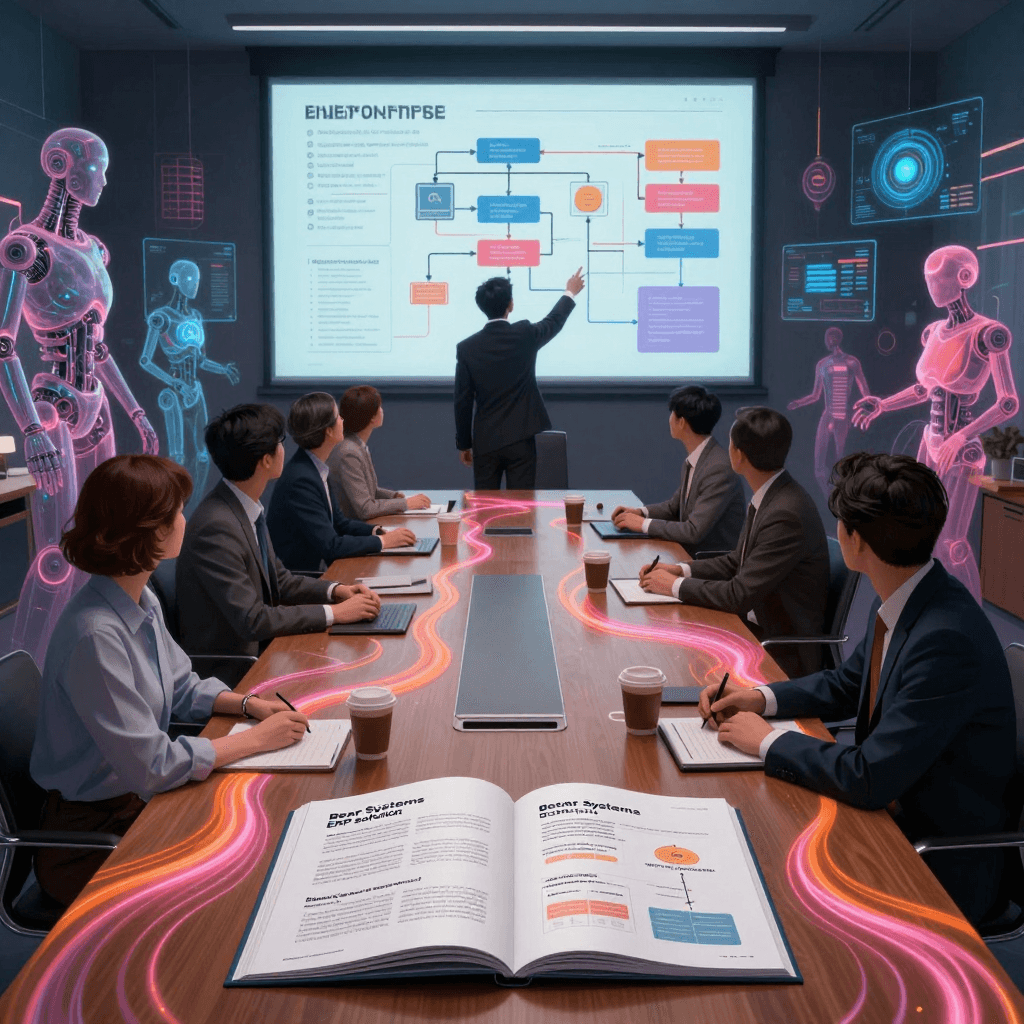
The Inflection Point: Moving Past Fragmented AI Experiments
For the past 24 months, enterprise AI has been characterized by 'Pilot Purgatory'—isolated Large Language Model (LLM) sandboxes and disjointed chatbots that fail to touch core business logic. We have reached a critical inflection point where the novelty of generative AI has been exhausted, and the demand for functional, integrated utility has arrived. The challenge is no longer 'Can AI do this?' but 'Can AI execute this within our complex, regulated ERP ecosystem?'
Current leadership frameworks are struggling to bridge the gap between unstructured data experimentation and the rigid, structured requirements of Enterprise Resource Planning (ERP) and Supply Chain Management (SCM). Most organizations are currently building 'islands of intelligence'—tools that can summarize a meeting or draft an email but lack the agency to execute a procurement order or reconcile a ledger without human intervention.
Operational Drag and the High Cost of Disconnected Systems
The cost of failing to transition to an agentic architecture is not merely a lost opportunity; it is an operational tax. When AI remains siloed from your core systems of record, you face massive technical debt through 'anual bridging'—human operators acting as the connective tissue between an AI tool and an legacy ERP. This creates a bottleneck that negates the speed advantages of AI.
Furthermore, the lack of a unified data fabric leads to hallucination risks in critical decision-making. In high-stakes environments like supply chain logistics or financial forecasting, an AI that cannot verify its output against real-time SCM inventory levels is a liability, not an asset. This fragmentation slows down the decision-making cycle, meaning by the time a human validates an AI-generated insight, the market window or the inventory shortage has already shifted.
Architecting for Agency: The Integrated Automation Framework
To escape this plateau, enterprises must move toward an environment built for agentic AI. As highlighted in recent industry discourse regarding [building the enterprise environment for agentic AI](https://www.technologyreview.com/2026/07/27/1140668/building-the-enterprise-environment-for-agentic-ai/), the focus must shift from simple prompting to building robust, permissioned environments where agents can act on your behalf.
At Bear Systems, we specialize in building these connective architectures. We don't just deploy models; we integrate agentic workflows directly into your existing HCM, ERP, and SCM stacks. This involves deploying specialized AI agents capable of performing multi-step reasoning tasks—such as autonomously reconciling discrepancies between purchase orders and warehouse receiving reports—while adhering to strict enterprise governance and security protocols. We transform your ERP from a passive system of record into an active engine of execution.
Quantifying the ROI of Autonomous Enterprise Workflows
The transition from 'Human-in-the-loop' to 'Human-on-the-loop' provides a structural shift in unit economics. In a traditional manual workflow, the cost of processing a single procurement exception scales linearly with volume. In an agentic workflow, the marginal cost of processing an exception approaches zero as the agentic agent masters the pattern.
Consider a scenario involving complex supply chain volatility. A traditional enterprise reacts to a delay after the shipment fails to arrive, triggering a cascade of manual emails, inventory re-adjustments, and procurement updates. An agentic enterprise, powered by an integrated SCM-AI agent, detects the anomaly via real-time data feeds, cross-references existing vendor SLAs, identifies an alternative supplier, and presents a completed transaction for a single-click approval. This reduces the 'Time-to-Resolution' from days to seconds, fundamentally changing the agility of the supply chain.
The End State: From Reactive Systems to Proactive Engines
What does success look like? It is an enterprise where the ERP is no longer a database that requires constant interrogation, but a proactive partner. In this state, your HCM systems identify talent gaps before they become vacancies by analyzing project pipeline data, and your SCM systems adjust procurement cycles based on predictive market signals without waiting for a quarterly review.
This requires a fundamental shift in leadership mindset: moving from supervising tasks to governing autonomous processes. The goal is a seamless data flow where information moves through agentic layers that understand not just the data, but the business context and the organizational intent.
Audit Your Agentic Readiness with Bear Systems
The divide between the 'AI-enabled' and the 'AI-powered' is widening. To avoid being left with a collection of expensive, useless tools, you must audit your current workflow-to-data connectivity. Bear Systems provides a technical readiness assessment to identify which of your high-volume, high-friction ERP and SCM processes are prime candidates for agentic automation. Schedule a deep-dive audit of your workflow complexity today.
Sources
Source: RealTimeNews — Why the AI-Powered Enterprise Urgently Needs a New Leadershi